

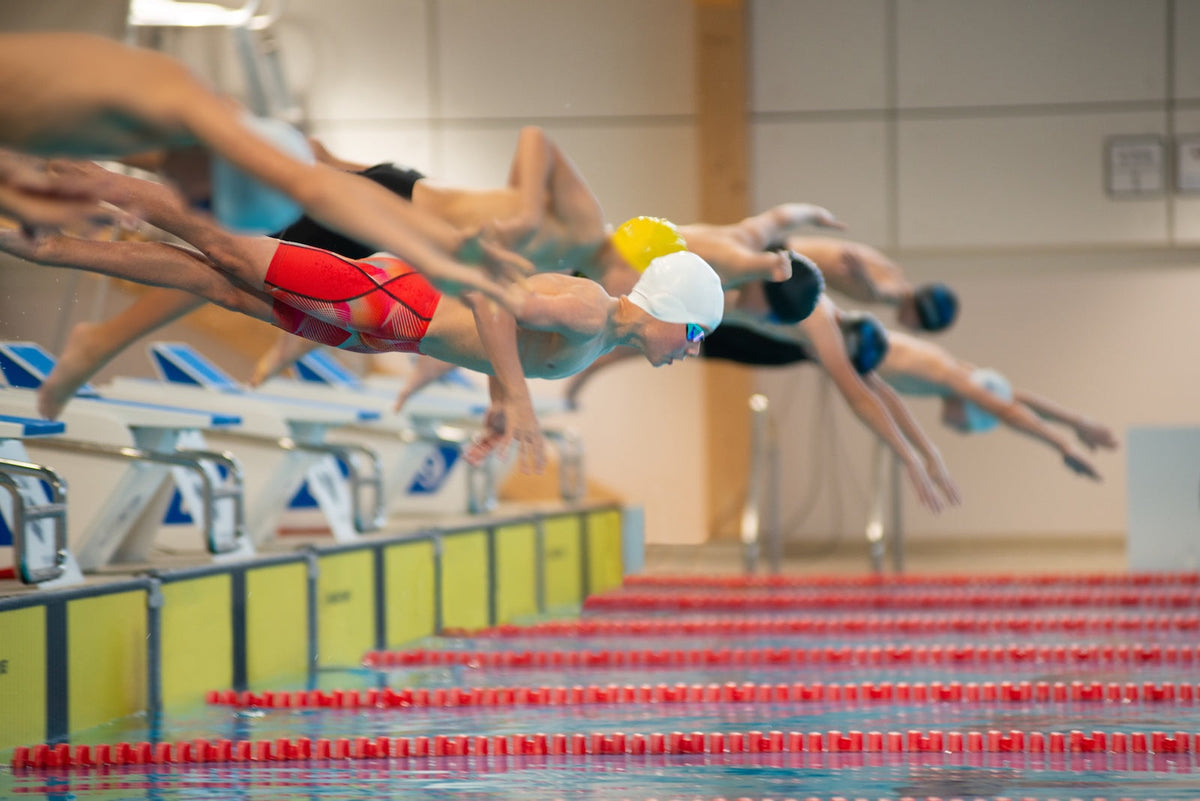
Why starts matter more than most swimmers think
A race can feel won or lost before you have taken your second stroke. If you have ever surfaced half a body length behind after what felt like a decent dive, you already know the start is not just a bit of pre-race theatre.
That matters because the swim start is its own performance skill, from the beep to the 15 metre mark, not just the moment your feet leave the block. A review of swim-start biomechanics found that time to 15 m can account for anywhere from 0.8% to 26.1% of total race time depending on the event, which is a massive chunk in sprint racing and still important in middle-distance events where early momentum counts Vantorre et al..
So yes, your aerobic engine matters. Your turns matter. Your pacing matters. But if your starts only happen as two rushed dives tacked onto the end of a brutal main set, you are probably undertraining a race skill that deserves fresh focus.
For competitive swimmers, that means better first-15-metre speed. For coaches, it means planning start work on purpose. For parents, it means understanding that a cleaner, further, calmer start is real progress even before the PB shows up.
The key phases of a swimming start
A strong start is not one action. It is a chain, and each link affects the next one.
1. Reaction
This is your response to the signal. The time is measured as the time taken between hearing the beep and the time it takes for your front foot to leave the blocks. Quick matters, but the research is very clear: quick alone is not enough. Vantorre and colleagues explain that swimmers must balance a brief reaction time with enough movement time on the block to generate high impulse and horizontal velocity. In plain English: getting off the blocks early is useless if you leave weakly.
2. Block performance
This is where you create the speed you will carry into flight and then into the water. A 2024 study of 152 high-level competitive swimmers found that on-block work, average power, horizontal take-off velocity and average acceleration all had a very large relationship with 15 m start time, with average power having the strongest impact.
The same study also showed a force sequence: rear leg first, then the arms pulling on the block, then the front leg. That is a great coaching reminder that a fast start is not just "jump harder". It is a coordinated whole-body push.
3. Flight
What happens in the air changes what happens in the water. You want enough distance and speed, but not a wild launch that turns into a splashy belly-flop or an over-deep entry. Flight needs to be smooth and controlled to ensure a perfect entry.
4. Entry
This is where shape matters. In a study on trained and sub-elite swimmers, entry state explained 86.1% of the variance in time to 15 m. Faster starts were linked to more horizontal distance before entry, higher horizontal velocity at water entry and a flatter entry angle.
That does not mean "dive flatter no matter what". The same paper points out that higher horizontal velocity alone does not automatically create a better start. You need the right combination of speed, distance and angle.
5. Underwater and breakout
The review by Vantorre and colleagues highlights that better starters preserve speed in streamline, time the end of the glide well, begin kicking at the right moment and avoid rushing into full stroking too early. This is where swimmers often throw away free speed by panicking and starting strokes before the body has finished travelling.
A simple cue: small hole in, tight line, patient breakout.
If you want to see what a near perfect dive looks like, take a look at this analysis of Cam McEvoy's start in his World Record breaking swim from 2026. The analysis starts a little slow but it highlights a few interesting takeaways worth paying attention to:
What sports science says about improving performance in training
The big lesson from the research is that the first 15 m is a distinct race skill. It is not just "swimming fast earlier". That is the best argument for training starts separately.
Here is what the evidence supports.
Train starts when you are fresh
Starts rely on reaction speed, explosive force and precise timing. Those qualities fade when you are cooked from butterfly kick on 1:10 and your legs feel like borrowed furniture. The research does not give one perfect weekly formula, but it strongly supports high-quality, race-specific practice rather than tired, random reps.
A practical setup could be:
- 4 to 8 starts early in the session
- Full recovery between reps
- One focus for the set: reaction, block push, entry, or breakout
- Simple feedback after each rep
Measure more than reaction time
Reaction time gets all the glamour because it is easy to see on the scoreboard, but it is only one piece. The block studies and reviews show that force production, take-off velocity and the quality of the underwater phase are huge parts of performance.
Useful measures include:
- Time to 15 m
- Entry distance
- Breakout point
- Number of underwater kicks
- Whether the entry stayed clean and narrow
If you can film from the side with a phone, even better. You do not need a biomechanics lab to notice whether you are popping up early, entering too steep, or cutting your streamline short.
Test setup instead of copying a teammate
The kick-start paper found the shortest 5 m times in that sample with a rear-weighted kick start from position 3 on an OSB12 block, and it also showed that shorter reaction time alone did not guarantee the best result.
Important bit: that does not mean everyone should use plate position 3 forever and tell the coach the science says so. It means block setup should be tested deliberately. Rear-weighted versus front-weighted. Different kick-plate positions. Small changes in knee angles. Repeated trials. Actual times.
The review evidence also stresses individualisation. There is no single perfect start model for every swimmer because body shape, event, strength and coordination style all matter.
Do not separate block and underwater in your head
Some coaches focus more on underwater speed, and that is fair. But the studies here show the phases are linked. Better block force helps create better take-off. Better take-off shapes entry. Better entry sets up a faster line underwater. So separate start training is not just "dive practice". It is rehearsing the whole first 15 m.
Practical start drills and common mistakes
Here are evidence-informed drills that fit real squad sessions.
1. Three-start quality set
Do 3 rounds of:
- 1 start focused on reaction and stillness at the signal
- 1 start focused on pushing through rear leg, hands, then front leg - in that order
- 1 start focused on clean entry and patient breakout
Rest fully between reps.
Helps fix: mindless volume, rushing, no clear focus.
2. Kick-plate testing ladder
Do 2 starts from one kick-plate setting, 2 from another, and 2 from a third. Keep effort high and compare time to 5 m or 15 m.
Helps fix: guessing your setup, copying faster swimmers with very different bodies.
3. Stick-the-streamline drill
Dive, enter through a small hole, and hold streamline to a marked distance before the first kick. Then repeat with one or two different breakout timings.
Helps fix: early arm movement, loose head position, panic stroking.
4. Flight-line video reps
Film from the side and check three things:
- Did you get out far enough?
- Was the entry clean rather than splashy?
- Did you enter at a useful angle rather than too steep or too flat?
Helps fix: over-diving, popping straight down, throwing yourself out with no control.
5. Dryland power pairing
On a separate day or before pool starts, use low-volume explosive work like:
- squat jumps
- broad jumps
- split-stance jumps
- medicine ball throws
This matches the evidence that average power and horizontal take-off velocity matter, especially for older competitive swimmers. Keep it coached and age-appropriate.
Helps fix: trying to improve starts through endless kilometres alone.
You can also work on reaction time training from anywhere, here's a great little clip that you can practice at home:
Common mistakes to watch for
- Leaving too soon: You beat the beep in your head, but you lose force on the block.
- Ignoring the rear leg: Research suggests the force sequence begins there, so a lazy rear leg often means a soft start.
- Chasing flat entry at all costs: Flatter can help, but only when speed, distance and angle work together.
- Breaking streamline early: This is one of the easiest ways to waste speed.
- Training starts when exhausted: tired dives build tired habits.
Notes for juniors, older swimmers and parents
For juniors, the goal is safe consistency first: stable set position, confident push, clean flight line and tight streamline. They do not need to look like an Olympic finalist next Tuesday.
For older teens and open swimmers, more individual testing makes sense, especially around kick-plate setup, power qualities and breakout timing.
For parents, praise the technical wins you can actually see:
- a calmer set position
- a cleaner entry
- surfacing further down the pool
- fewer scrappy movements before breakout
Those are often the signs that a race PB is on the way.
The takeaway for faster race openings
If you want a faster first 15 m, do not treat starts like an afterthought. The evidence points the same way: reaction time matters, but so do block power, take-off velocity, entry shape and underwater timing. That is why starts should be trained separately, in small batches, with fresh legs, clear feedback and enough patience to find what works for your body.
Next session, do not just dive in and hope. Pick one start focus, film a few reps, and train the first 15 m like it actually counts - because it does.
References
- Vantorre, Chollet, Seifert (2014), Biomechanical analysis of the swim-start: a review
- Thng, Pearson, Mitchell et al. (2024), On-block mechanistic determinants of start performance in high performance swimmers
- van Dijk, Beek, van Soest (2020), Predicting dive start performance from kinematic variables at water entry in (sub-) elite swimmers
- Matúš, Ružbarský, Vadašová (2021), Key Parameters Affecting Kick Start Performance in Competitive Swimming


