

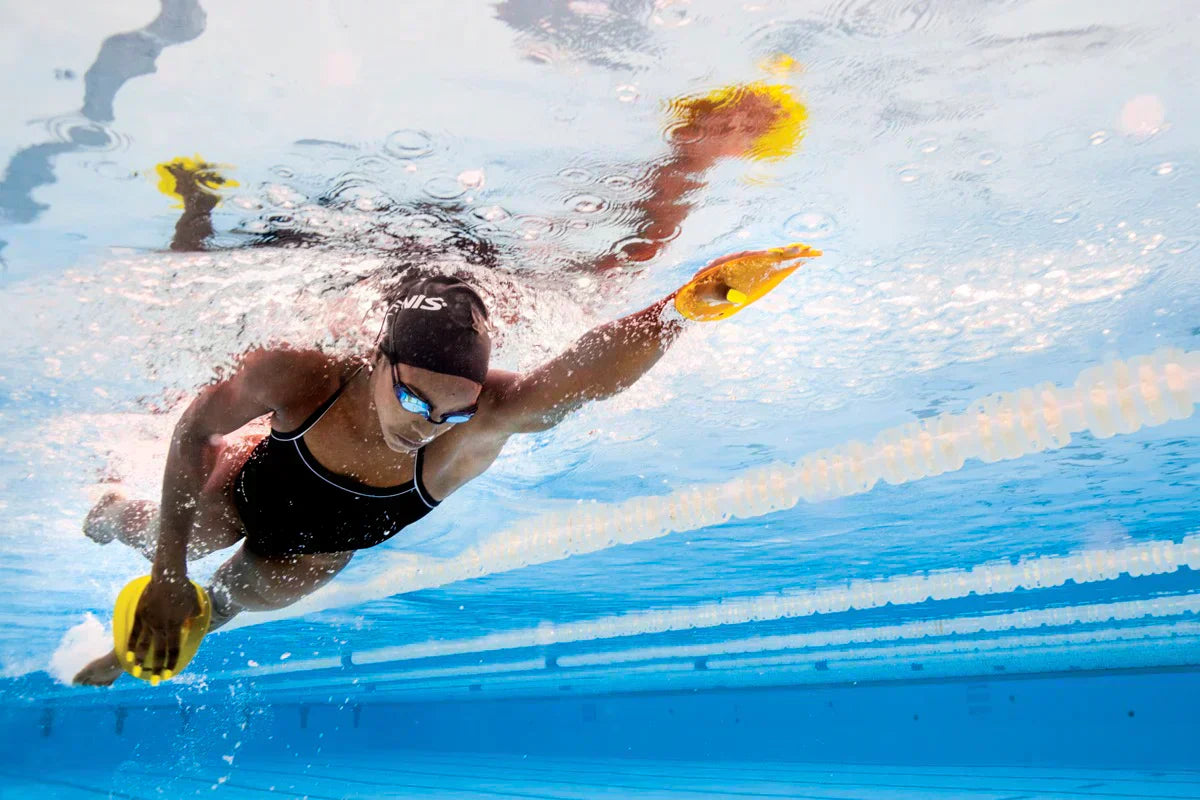
Hand Paddle Types for Swimming: Which One Suits Your Training?
Hand paddles can be one of the most useful tools in swim training - or one of the easiest to misuse.
Used well, they help you feel the water, build strength and sharpen your catch. Used badly, they can turn a tidy stroke into a shoulder-grinding mess that feels powerful but actually makes you slower.
That is why the right paddle matters. A 10-year-old learning freestyle rhythm does not need the same paddle as an experienced masters swimmer doing a pull set, and not every paddle shape does the same job.
If you are trying to work out which hand paddle suits your swim training, here is the short version:
- Flat paddles are best for classic strength and pressure-on-the-water work
- Curved paddles often feel smoother and more natural through the pull
- Finger paddles are best for technique, catch awareness and younger swimmers
- Ergonomic paddles are useful for targeted feedback and fixing specific stroke issues
The best choice depends on your goal, stroke quality, age and shoulder tolerance - not just on what looks hardest in the swim shop.
What hand paddles actually do in training
Hand paddles increase the surface area of your hand in the water. In practical terms, that means more pressure during the pull.
That usually creates one or more of these training effects:
- more resistance, so the upper body works harder
- better awareness of hand position during the catch and pull
- clearer feedback when your stroke slips
- more propulsion if your technique is already sound
But there is a trade-off. Paddles do not just magnify force - they magnify errors too.
Research on swimming drag shows that body alignment and streamline have a major effect on resistance in the water, and even small changes in limb or torso position can meaningfully increase drag. Enlarging hand surface area with paddles can intensify these effects, which is why technique still has to come first.
In other words, paddles are a tool, not a shortcut.
If your head lifts, your core switches off, or your hand entry crosses over, paddles will not fix it for you. More often, they make the problem more obvious.
Hand paddle types at a glance
| Paddle type | Best for | Main benefit | Main drawback |
| Flat paddles | Strength sets, freestyle and butterfly pull work | Clear pressure feedback and added resistance | Can encourage muscling through the stroke and overload shoulders if too large |
| Curved paddles | Swimmers who want a more natural catch feel | Smoother pull and less clunky feel | Can make a flawed stroke feel better than it is |
| Finger paddles | Technique, younger swimmers, catch awareness | Builds feel for the water without heavy load | Limited strength benefit |
| Ergonomic paddles | Technical feedback, advanced swimmers, targeted drills | Exposes stroke flaws and guides hand position | Less beginner-friendly and often more specialised |
The main types of hand paddles
Flat paddles
These are the classic hand paddles. Usually rectangular or oval-shaped, they have a rigid surface with straps for the fingers and wrist.

Best for:
- general strength sets
- developing feel for pressure on the water
- swimmers with already decent technique
- freestyle and butterfly pulling work
What they do well: Flat paddles give very clear feedback. If your catch is clean and your pull path is solid, they let you feel a strong hold on the water. They are also common, affordable and easy to fit into regular training.
Possible drawbacks: Because they are simple and often larger, they can encourage swimmers to muscle through the stroke instead of holding good shape. If you are dropping the elbow underwater or crossing over on entry, flat paddles will not hide it. Go too big too soon and your shoulders may let you know. Speak to your coach to make sure flat paddles are a good fit, we typically wouldn't recommend them for Junior swimmers.
Reality check: If you feel like a machine during the paddle set but your stroke falls apart as soon as the paddles come off, the paddle may be too large or you may be relying on strength more than technique.
Curved paddles
Curved paddles are shaped to follow the hand more closely. Some have a spoon-like profile that changes how the water moves over the hand. They also often include straps or silicone bands for holding paddles in place.

Best for:
- swimmers working on a more natural catch feel
- stronger swimmers who want resistance without a harsh feel
- freestyle and backstroke technique-strength work
What they do well: These paddles often feel smoother through the pull and can help swimmers connect with the water rather than simply shove against it. Many swimmers prefer them because they feel less clunky than flat paddles.
Possible drawbacks: They can make a flawed stroke feel nicer than it really is, which is not ideal when the goal is honest feedback. Some swimmers also become too dependent on the shape of the paddle instead of learning to create pressure with the hand and forearm.
Good use case: If you already have solid basics and want to build pulling strength while keeping a more natural hand position, curved paddles can be a good fit.
Finger paddles
Finger paddles sit mainly under the fingers rather than covering the whole hand. They are much less about brute force and much more about skill.

Best for:
- younger swimmers
- technique sessions
- catch awareness
- reducing overload on shoulders
- learning to hold water properly
What they do well: Finger paddles are excellent for teaching feel for the water. Because they do not add huge resistance, they let you focus on hand entry, catch angle and pressure without turning every set into an upper-body grind. They are especially useful for swimmers still developing stroke mechanics.
Possible drawbacks: If your goal is serious strength work, finger paddles will not provide the same training load as full-size paddles. Some swimmers expect them to feel dramatic and are disappointed by how subtle they are. But subtle is often the point.
Why coaches like them: They are a safer entry point for paddle work, especially for age-group swimmers who are still growing and refining technique.
Ergonomic paddles
These are the more specialised options. They may have unusual contours, no wrist strap, guided hand placement, or features designed to improve stroke path and catch mechanics.

Best for:
- swimmers wanting technical feedback
- advanced squad swimmers
- correcting specific stroke issues
- coaches using targeted drill progressions
What they do well: Some ergonomic paddles are excellent at exposing flaws. No wrist strap, for example, means the paddle will shift or fall off if your hand position is poor. Others encourage a better catch shape or more stable pressure through the pull. They can be very useful when you know exactly what you are trying to fix.
Possible drawbacks: They are not always beginner-friendly, and they can be confusing if you do not understand their purpose. Fancy design does not automatically mean better results. If the swimmer lacks basic body position and stroke control, they may just become expensive lane-bag decoration.
Which hand paddle suits which training goal?
The easiest way to choose swim paddles is to start with the goal rather than the brand.
If your goal is strength and power
Choose:
- flat paddles
- larger curved paddles
These work well in pull sets, aerobic strength sets and race-pace pulling work. Just do not jump straight to the biggest size available. Bigger is not always better - often it is simply harder on the shoulders.
If your goal is stroke development
Choose:
- finger paddles
- smaller ergonomic paddles
These help you feel the early catch, improve hand placement and build better awareness without overwhelming the stroke.
If your goal is honest technical feedback
Choose:
- ergonomic paddles with minimal straps
- smaller flat paddles
- finger paddles
These expose mistakes quickly. If your hand enters poorly or your pull path is messy, you will know about it.
If your goal is all-round squad use
Choose:
- smaller ergonomic paddles
- medium sized curved paddles
These are the most versatile options for swimmers who already have a decent stroke and want a blend of strength and feel.
Squad swimmers note: Always check with you coach first! Your coach will almost certainly have a preference over which type of paddle they'd prefer you to use.
How to choose the right paddle for your level
Age and physical development
For younger swimmers, smaller is smarter. Finger paddles or very small hand paddles are usually the better choice because they teach feel without loading the shoulders too heavily.
For older teens and adults, medium paddles are often enough for most training goals. Very large paddles should be used carefully and usually only by stronger, technically sound swimmers under coach guidance.
Skill level
If you are still learning how to hold water, do not start with giant paddles. They can mask problems, overload joints and easily lead to injury if used incorrectly.
A simple guide:
- Beginners and younger age-group swimmers: finger paddles or small ergonomic paddles
- Intermediate swimmers: small to medium flat, ergonomic or curved paddles
- Advanced swimmers: medium to large paddles depending on the set and stroke quality
Stroke focus
Different strokes respond differently to paddle use.
- Freestyle: most paddle types can work depending on the goal
- Backstroke: curved or smaller paddles often feel more natural
- Butterfly: paddles can be useful, but size matters because shoulder load rises quickly
- Breaststroke: use with care and ideally with coach guidance, as timing and hand path are very specific
Technique under fatigue
This is where a lot of swimmers misjudge paddle choice.
The right paddle is not the one that feels impressive for the first 50. It is the one you can still use with solid form halfway through the set when you are tired.
If your stroke falls apart with a certain paddle, it is probably too big, too advanced, or simply wrong for that session.
Why technique matters more than paddle size
Small changes in body alignment can significantly affect drag, and increasing hand surface area can magnify those hydrodynamic effects. In practice, that means paddles can amplify good mechanics, but they can just as easily amplify bad ones.
That is why swimmers often get better results from a smaller paddle used well than a huge paddle used poorly.
A paddle should help you:
- hold a better catch
- feel clean pressure on the water
- maintain alignment through the stroke
- transfer improvements back to normal swimming
If it does not do those things, it may not be the right paddle for you.
Smart paddle rules for every swimmer
Before you add paddles to every set, keep these basics in mind:
- Start small and earn your way up
- Prioritise clean technique over paddle size
- Stop if you feel shoulder pain, not just normal fatigue
- Use paddles for a reason, not just because everyone else in the lane is
- Pair paddle work with body position cues such as a steady head, engaged core and long line
- Take the paddles off and check whether the improvement carries over
That last point matters most. The goal is not to become good at swimming with gear. The goal is to swim better without it.
Common mistakes when choosing swim paddles
A few problems show up again and again:
- Choosing the biggest paddle available: this usually increases load faster than it improves technique
- Using paddles too early: beginners often need feel and body position work first
- Ignoring shoulder discomfort: soreness is a warning sign, not a badge of honour
- Using one paddle for every set: different sessions have different goals
- Mistaking resistance for improvement: harder does not always mean better
Avoiding these mistakes will do more for your training than chasing a more aggressive paddle design.
The bottom line
There is no single best hand paddle for swimming - only the best one for your current stage, stroke and training goal.
- Flat paddles are strong all-rounders for classic strength work
- Curved paddles can feel smoother and more natural through the water
- Finger paddles are excellent for technique, catch awareness and younger swimmers
- Ergonomic paddles can provide excellent feedback when used for a specific purpose
The smartest choice is the paddle that helps you improve your stroke, not just survive a harder set.
If you are unsure, start smaller, focus on quality and ask your coach what problem the paddle is meant to solve. In swimming, more resistance only helps if you are moving through the water well in the first place.
So next time you are staring at a wall of plastic and wondering why there are so many shapes, do not just grab the biggest pair in the mesh bag. Choose the pair that actually makes you better.


